Edge deployment of small language models (SLMs) is fundamentally limited by the memory-bound decode stage and insufficient batch-level parallelism.
- Existing LLM accelerators become highly inefficient with concurrent user requests, irregular sequence lengths, and strict power constraints.
- Non-linear operations such as Softmax and RMSNorm interrupt GEMV execution.
- KV-cache accesses introduce significant memory and bandwidth overhead.
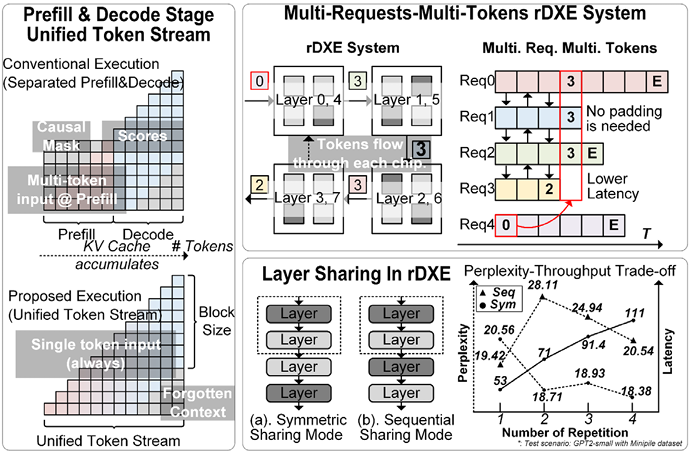
This work proposes rDXE, a scalable ring-based decoder accelerator for edge SLM inference.
- The architecture introduces token-level pipelining to enable efficient multi-request and multi-token execution while maintaining high hardware utilization.
- A Vector Recompute (VRC) mechanism fuses nonlinear operations directly into the GEMV pipeline to reduce latency without sacrificing accuracy.
- An irregular-write uniform-read (iWuR) KV-cache organization with hardware-efficient GQA support is proposed to improve data reuse, reduce memory traffic, and lower KV-cache storage requirements.
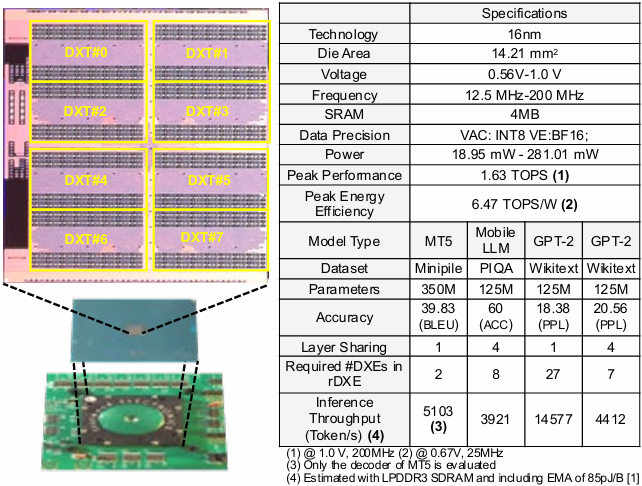
The proposed accelerator was fabricated in 16nm FinFET technology. Measurement results show up to 5.26 TOPS/W energy efficiency and 11.16 μJ/token decoding energy. The token-level pipeline sustains up to 77.8% utilization and achieves up to 4412 tokens/s throughput in scalable multi-chip configurations. In addition, VRC achieves up to 4.66× latency reduction for nonlinear layers, while the optimized KV-cache organization reduces latency by up to 1.54× and KV-cache capacity demand by up to 83%.